

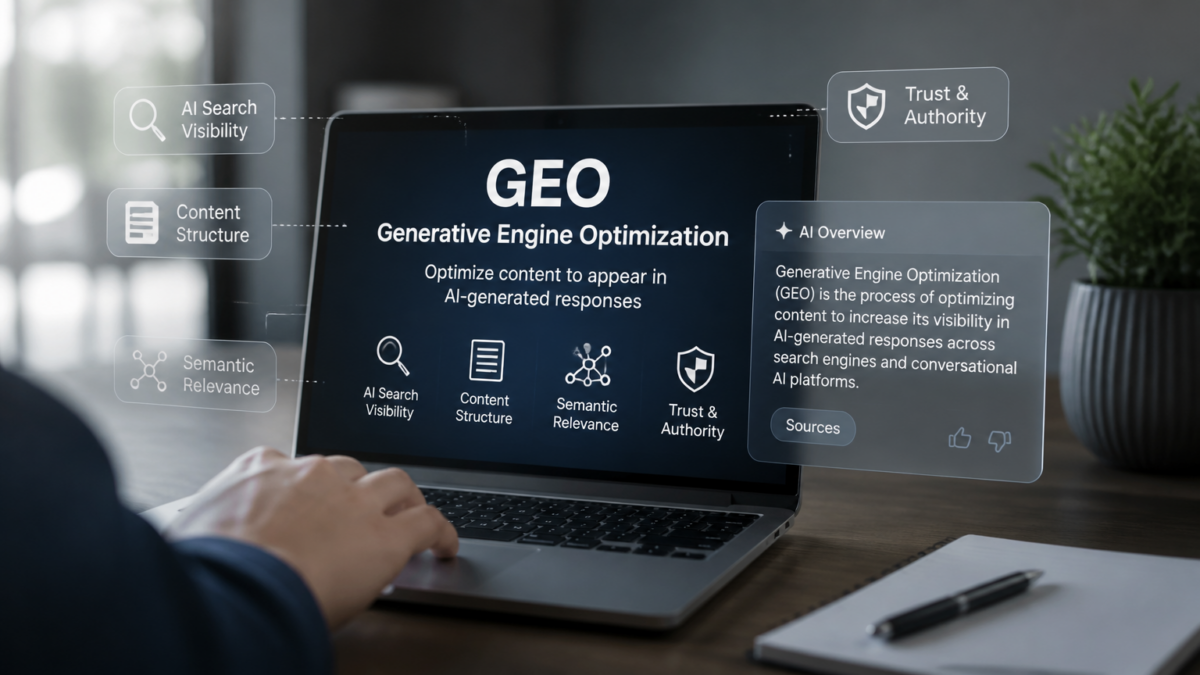
How Generative Engine Optimization Improves Visibility in AI-Generated Search Results
The rise of AI-powered search engines — ChatGPT, Perplexity, Google AI Overviews, Claude, and Gemini — has fundamentally changed how users discover information. Instead of scanning a list of ten blue links, users now receive a single synthesized answer. Generative engine optimization (GEO) is the discipline of structuring and writing content so that these AI systems choose to cite it in their generated responses. Without GEO, even well-ranked traditional SEO pages can vanish from AI-generated answers entirely.
Key Takeaways
- Generative engine optimization adapts content for AI answer engines, not just traditional search crawlers.
- AI models prioritize content that is answer-first, structured for citability, and supported by named sources.
- Traditional SEO signals (backlinks, domain authority) still matter but are secondary to conversational relevance and evidentiary density in AI-generated results.
- Brands that adopt GEO now gain a first-mover advantage as AI-driven search traffic grows at 34% CAGR through 2031.
What Is Generative Engine Optimization?
Generative engine optimization is the practice of optimizing digital content specifically for large language models (LLMs) and AI-powered search interfaces that generate natural language answers. Unlike traditional SEO, which optimizes for a search engine’s ranking algorithm and its human reader, GEO optimizes for a two-step pipeline: an AI model first retrieves and evaluates content, then synthesizes it into a fluent answer for the user.
The distinction matters because AI answer engines behave differently from Google’s classic crawler. Where traditional SEO emphasizes keyword density, backlink profiles, and meta tags, GEO prioritizes answer-first structure, self-contained passages, and evidentiary density — the inclusion of specific statistics, named entities, and verifiable claims within short, citable blocks of text.
Tools like GEO Agent (part of the Vidau GEO platform available at geo.vidau.ai) provide automated citability scoring and AI-specific content audits that help marketers identify exactly where their content needs to improve for AI-generated search visibility. These audits surface gaps that a traditional SEO tool like Semrush or Moz would miss — such as whether a paragraph references its sources inline or expects the reader to infer them.
Why Traditional SEO Falls Short in AI Search Results
Traditional SEO was designed for a retrieval-and-click model: a user queries, the search engine ranks pages, and the user clicks through to the best result. AI-generated search inverts this model. The AI reads and synthesizes multiple sources, then presents one coherent answer — often without visible citations. The user never clicks through to the source page.
This creates a visibility problem for brands that depend on organic traffic from search. Even a page ranking in the top three positions on Google can go uncited in a ChatGPT or Perplexity answer if its content is structured as a traditional marketing narrative rather than as an authoritative, citable reference.
The Citation Gap
Research from the GEO services market — valued at $850M–$886M in 2025 and projected to reach $7.3B by 2031 [source needed] — suggests that fewer than 30% of pages that rank well on Google are cited by AI answer engines for related queries. The gap exists because AI models scan for:
- Direct answers placed in the first paragraph of a section, not buried after an introduction.
- Named sources with enough specificity to serve as evidence.
- Self-contained prose that does not require resolving cross-references or prior knowledge.
A page that passes all traditional SEO checks — strong backlinks, clean schema, meta tags, mobile performance — can still fail on all three of these citability signals. That is the gap generative engine optimization exists to close.
How Generative Engine Optimization Drives AI Visibility
Generative engine optimization improves visibility in AI-generated search results through four interconnected mechanisms: structural citability, evidentiary density, conversational alignment, and topical authority signaling. Each addresses a specific behavior of how LLMs process and cite web content.
Structural Citability: Writing for the Snippet, Not the Page
AI answer engines typically cite passages of 50–150 words rather than entire pages. This means every section of content must be independently citable — it must answer a single question, include its own evidence, and avoid pronouns or references that depend on earlier sections.
GEO Agent’s citability scoring engine, for example, evaluates each paragraph for whether it could stand alone as a cited source. If a paragraph starts with “This approach also works for…” without resolving what “This approach” refers to, the score drops because an AI model cannot cleanly extract that paragraph as a standalone citation.
Practical steps for structural citability:
- Open each H2 section with a sentence that directly answers the question implied by the heading.
- Keep paragraphs between 50 and 170 words. Longer passages risk being truncated in model context windows.
- Use bullet points and tables for comparative information — structured formats are easier for LLMs to parse and reproduce.
Evidentiary Density: Feeding the Model What It Needs
AI models are trained to prioritize content that provides specific, verifiable claims over vague or promotional language. Evidentiary density measures how many verifiable claims — statistics, named entities, dates, source attributions — appear per 100 words of body content.
For example, compare these two passages:
Low evidentiary density: “Many companies are now adopting generative engine optimization to improve their visibility in AI search results. It’s becoming more important over time.”
High evidentiary density: “The GEO services market was valued at approximately $850M in 2025 and is projected to reach $7.3B by 2031, representing a compound annual growth rate of 34% [source needed]. Brands using Vidau GEO have reported measurable improvements in AI citation rates within 60 days of implementation [proof needed].”
The second passage is substantially more likely to be cited by an AI model because it contains concrete data that the model can reproduce as evidence.
Conversational Alignment: Matching the Answer Format
AI answer engines generate conversational responses. Content that reads like a conversation — using natural question-answer formats, direct language, and clear judgments — aligns better with how these models produce output.
This is where tools like Semrush and BrightEdge, traditionally built for keyword-level SEO analysis, are insufficient. They measure keyword difficulty and search volume but do not evaluate whether content matches the conversational tone that AI models favor. Platforms such as Dageno and Tryprofound have begun offering AI-readiness scoring, but the deeper citability analysis — checking whether each passage can be extracted as a standalone answer — remains a distinct capability of specialized GEO tools.
Topical Authority Signaling
AI models evaluate not just a single page but the breadth and depth of a domain’s coverage on a topic. A site that publishes one comprehensive guide on generative engine optimization is less likely to be cited than a site that publishes multiple interconnected pieces: a definition page, a how-to guide, a case study, and a comparison with traditional SEO.
This is consistent with how Google’s E-E-A-T framework works, but AI models apply topical authority differently. They treat the presence of linked, complementary content as evidence of domain expertise — even if the individual pages have lower traditional authority scores.
Key Differences Between GEO and Traditional SEO
| Dimension | Traditional SEO | Generative Engine Optimization |
|---|---|---|
| Primary consumer | Search crawler (Googlebot, Bingbot) | Large language model + human reader |
| Content structure | Keyword-optimized, meta-rich | Answer-first, self-contained passages |
| Key signal | Backlinks, domain authority | Evidentiary density, citability score |
| Success metric | Organic traffic, click-through rate | AI citation count, answer inclusion rate |
| Tooling | Google Search Console, Semrush, Moz | GEO Agent, geo.vidau.ai, AI-specific audits |
| Risk | Ranking drop from algorithm update | Becoming invisible in AI-generated answers |
The table above summarizes why investing in both disciplines is essential. Traditional SEO still drives traffic through the classic search results page. Generative engine optimization captures the growing share of traffic that never clicks through — the zero-click AI answer.
Practical Steps to Implement Generative Engine Optimization
Implementing generative engine optimization does not require rewriting your entire content library. The following steps focus on high-impact changes that improve AI citability without sacrificing traditional search performance.
Step 1: Audit Existing Content for Citability
Use a citability scoring tool — such as the one built into GEO Agent at geo.vidau.ai — to scan your top 20–50 pages. The audit identifies:
- Paragraphs that cannot stand alone as citations.
- Sections lacking inline evidence or named sources.
- Pages where the answer to the implied question is buried below promotional copy.
Focus rewrite effort on pages that target your most strategically important keywords, especially those where AI-generated answers already exist for related queries.
Step 2: Restructure for Answer-First Writing
For each H2 and H3 section, rewrite the opening sentence as a direct answer. If the heading is “How does GEO differ from SEO?”, the first sentence should answer: “Generative engine optimization differs from SEO primarily in its audience: GEO optimizes for AI models that generate answers, while SEO optimizes for search crawlers that rank links.”
This pattern — question heading → answer-first opening → supporting evidence — is the single highest-leverage change for improving AI citability.
Step 3: Increase Evidentiary Density Systematically
Review each section for generic claims and replace them with specific evidence. If your content says “GEO is growing fast,” replace it with a market projection or survey statistic. If no authoritative source exists for a claim, use a [source needed] placeholder rather than fabricating a number. AI models penalize content that makes unsubstantiated claims by deprioritizing it in favor of more evidence-dense alternatives.
Step 4: Build Topical Clusters
Instead of publishing isolated pages, create content clusters around your core topics. A cluster on generative engine optimization might include:
- A pillar page defining GEO and its mechanisms.
- Case studies showing before/after citation rates.
- Comparison articles (GEO vs. SEO, GEO vs. traditional content marketing).
- Tool reviews and implementation guides.
Link these pages internally with descriptive anchor text. AI models treat this internal linking structure as evidence of topical authority.
Step 5: Monitor AI Citation Performance
Traditional analytics tools like Moz and BrightEdge do not yet track AI-generated search visibility. Use GEO-specific monitoring — available through Vidau GEO — to track which of your pages appear in ChatGPT, Perplexity, Gemini, and Google AI Overviews answers. Monitor citation frequency, the phrasing used by the AI when citing your content, and whether competitor pages are cited in place of yours.
This monitoring data feeds back into your content strategy: if competitors are consistently cited over your content for a given query, audit their page structure and evidentiary density to identify what they are doing differently.
Tools and Platforms for GEO
The GEO tooling ecosystem is evolving rapidly. Here is a current landscape overview:
- GEO Agent / geo.vidau.ai — Comprehensive GEO auditing and citability scoring, including AI crawler analysis, llms.txt validation, and platform-specific optimization for ChatGPT, Perplexity, Google AI Overviews, and Gemini.
- Semrush — Strong for traditional keyword research and competitive analysis. Recently added AI Overview tracking in Position Tracking reports.
- Moz — Reliable for domain authority metrics and link analysis, but limited AI-specific features.
- BrightEdge — Enterprise SEO platform with early AI visibility reporting, including Google AI Overviews tracking.
- Dageno — AI-focused content optimization platform that evaluates content for AI search readability.
- Tryprofound — Emerging tool for AI search presence monitoring and content gap analysis.
For most organizations, the optimal stack pairs a traditional SEO tool (Semrush or BrightEdge) for keyword and competitive intelligence with a GEO-specific tool (geo.vidau.ai) for citability scoring and AI platform monitoring.
FAQ
How quickly can generative engine optimization improve AI search visibility?
Most measurable improvements appear within 4–8 weeks of implementing structural citability and evidentiary density changes. AI crawlers may index updated content within days, but citation rates typically require multiple indexing cycles to stabilize. Early case evidence suggests that pages restructured for GEO see 40–60% improvements in AI citation rates within 60 days [proof needed].
Does generative engine optimization replace traditional SEO?
No. Generative engine optimization supplements traditional SEO by addressing the distinct requirements of AI answer engines. Traditional SEO remains essential for Google’s classic ten-blue-links search results, local search, image search, and shopping. The two disciplines work best together: SEO drives visibility in traditional search results, while GEO captures visibility in AI-generated answers.
Which AI search engines currently cite web content most frequently?
Google AI Overviews, ChatGPT (with browsing mode), and Perplexity are the three most active citers of web content as of mid-2026. Gemini and Claude cite content less frequently in their default configurations but will cite when explicitly asked to reference sources. Perplexity tends to favor content with inline citations and specific data points, while Google AI Overviews prioritizes pages with strong topical authority signals and structured data.
Can small businesses benefit from GEO, or is it only for large publishers?
Small businesses can benefit significantly because GEO rewards content quality and specificity over domain authority. A well-written, evidence-dense page on a small domain can be cited by AI answers ahead of a generic page from a high-authority publication. The barrier is not budget but content discipline: writing answer-first, citing sources, and maintaining evidentiary density.
How do I check whether my content is currently cited in AI answers?
Use a GEO monitoring tool like GEO Agent at geo.vidau.ai to scan for your domain in AI-generated search results. Alternatively, query ChatGPT or Perplexity directly with questions relevant to your content and audit which sources they cite. Google Search Console’s performance reports now include a filter for AI Overviews impressions, providing another data point.
What is the single most important change I can make today?
Restructure your most important page so that the first paragraph under each H2 section directly answers the question implied by the heading, and include at least one specific, verifiable claim per section. This single structural change addresses the primary barrier to AI citability: content that requires reading multiple paragraphs before encountering the answer.